
How to Bypass CTR and Impression Velocity Restrictions on YouTube to Protect Automation from Deductions
YouTube uses complex mathematical models to distribute traffic among uploaded videos. CTR (Click-Through Rate) and Impression Velocity (the speed of accumulating impressions) metrics determine how quickly the platform's algorithms promote new content into recommendations. For automation software developers and SMM engineers, understanding these parameters is critical, as sudden spikes in impressions without corresponding audience retention lead to view deductions and channel penalization. PR Motion specialists help optimize network requests and configure behavioral factors for safe promotion. Understanding the principles of how retention algorithms work allows the creation of stable systems for channel promotion.
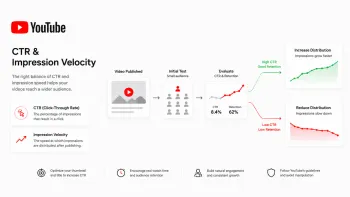
What are CTR and Impression Velocity on YouTube in Simple Terms
CTR and Impression Velocity on YouTube are key behavioral metrics, where CTR reflects the percentage ratio of clicks on a video thumbnail to the total number of its impressions, and Impression Velocity measures the speed at which these impressions are distributed by the algorithmic system in the first hours after publication.
The programmatic meaning of these indicators lies in evaluating the "freshness" and relevance of content for specific audience segments. When a new video is loaded, the player and server exchange data, initializing a session whose structure partially relies on the state management standards described in the RFC 6265 specification. If the first viewers actively click on the video, the algorithm records a high CTR and triggers a landslide growth of impressions — Impression Velocity.
When a user hovers their cursor over a video thumbnail, YouTube registers an impression. If the user clicks, the system records a transition. The speed at which these impressions are distributed across the platform is the Impression Velocity. The YouTube algorithm works on a feedback loop principle: if the initial audience response is positive, the system accelerates the distribution of impressions, testing the video on wider segments of users.
PR Motion specialists emphasize that a sharp increase in impressions without audience retention (Audience Retention) is regarded by Google's security system as artificial manipulation. To prevent blocks, it is necessary to synchronize the click generation rate with the actual video watch time. Using dynamic mobile proxies from PR Motion allows avoiding this problem due to the constant rotation of network addresses.
When the algorithm detects a mismatch in parameters, it invalidates the session and requests a password re-entry or two-factor authentication. This makes classic session transfer between devices impossible without preliminary preparation of the network environment. PR Motion engineers recommend using specialized tools for precise emulation of the source device.
How CTR and Impression Velocity Algorithms Work on YouTube
CTR and Impression Velocity algorithms on YouTube work on the principle of cascade testing of content on small groups of users, followed by expanding reach, provided that high click-through rates and retention are maintained.
In the official Google study Deep Neural Networks for YouTube Recommendations, a two-stage neural network ranking model is described in detail. The process of evaluating CTR and impression speed consists of the following stages:
- Primary distribution (Seed Audience). The video is shown to a small group of subscribers and active viewers of similar channels to collect baseline metrics.
- Calculation of initial CTR. The server records the number of video thumbnail impressions and subsequent clicks via requests to the
api/stats/playbackendpoint. - Retention evaluation (Watch Time). The algorithm measures the continuity of the view and the transmission of periodic ping packets (heartbeats) from the player.
- Activation of Impression Velocity. When threshold CTR and retention values are exceeded, the neural network begins to exponentially increase the number of impressions in recommendations.
- Traffic cross-validation. The security system checks the network parameters of sessions, including TLS fingerprints (JA3/JA4) and IP address types.
- Reach adjustment. If CTR drops as the audience expands, the algorithm slows down the impression speed to stabilize the load on the servers.
The mathematical model of Impression Velocity is described by a differential equation, where the rate of change in impressions depends on CTR and average view duration (AVD). If these indicators fall below a critical level, the algorithm stops promoting the video.
Developers of automation libraries on GitHub confirm that Google's algorithms instantly detect pattern delays between requests. PR Motion engineers solve this problem by implementing algorithms for dynamic IP address rotation and emulating human behavior at the network request level. This allows distributing the load so that the script's actions do not differ from the activity of an ordinary person.
In addition, the security system analyzes the history of the account's interactions with other videos. If a session consists only of views of a single target video without transitions to related videos, the algorithm regards this as manipulation. PR Motion specialists configure session warming scenarios that simulate the full behavior of a real user with all associated actions.
Technical Parameters and Limits of CTR and Impression Velocity
Technical parameters of CTR and Impression Velocity determine the allowed boundaries of changes in click-through rates, impression generation speed, and network metrics, beyond which views are deducted.
Each session is evaluated by multiple parameters. If the system detects discrepancies in critical metrics, views are invalidated. PR Motion specialists have systematized key parameters and limits in a detailed table below, based on security research and open data from private API developers.
| Scenario or data type | Limit (Rate Limit / Codec / Metric) | Consequences of Exceeding / Deductions | Data Source |
|---|---|---|---|
| Average CTR for new videos | From 2% to 10% in the first 24 hours | Decrease in Impression Velocity when falling below 2% | YouTube Analytics API Docs |
| Using datacenter IPs (Datacenter) | 0% allowed traffic for click manipulation | Instant session block, view deduction | PR Motion Tech Blog |
| Mismatch of TLS fingerprint (JA3/JA4) | 0 mismatches allowed in a session | WebSocket connection reset, IP ban | OWASP Session Management |
| Frequency of requests to api/stats/playback | No more than 5 requests per minute from a single IP | Temporary IP address block, CAPTCHA | GitHub youtube-viewbot |
| Using AV1 codec when emulating | Requires hardware GPU support | View deduction due to hardware profile mismatch | Google Video Codecs Guide |
When configuring automation, it is important to remember that limits are calculated dynamically. If a video receives a sudden spike in views with low retention, Google's algorithm pauses the video's promotion. PR Motion engineers recommend gradually increasing activity, starting with minimal values in the first hours after the video is published.
It is also critically important to monitor the uniqueness of network fingerprints. Using identical TLS handshake parameters is quickly recognized by spam filters. PR Motion specialists advise using only high-quality mobile proxies that mask network activity as real users.
How PR Motion Solves the CTR and Impression Velocity Problem
The PR Motion platform solves the problem of strict CTR and Impression Velocity limitations by providing a pool of clean residential mobile proxies with CGNAT technology support and automatic IP address rotation via API or timer.
Our network infrastructure is built on physical hardware connected to major cellular carriers. This guarantees that each issued IP address possesses the highest trust level from Google's security systems. Blocking such an address is impossible, as cellular carriers share a single public IP among thousands of real smartphone users.
Solutions from PR Motion contain:
- Full support for HTTP(S) and SOCKS5 protocols for integration with any automation software.
- Ability to configure IP address rotation on a flexible schedule or on request via HTTP API.
- Automatic masking of WebRTC and DNS parameters to prevent real IP address leaks.
- Compatibility with all popular anti-detect browsers to create unique digital fingerprints.
Using mobile proxies from PR Motion allows distributing requests from hundreds of accounts through dynamic gateways. This eliminates the linking of profiles based on network characteristics and reduces the likelihood of view deductions to a minimum. You get a stable tool for scaling your business on YouTube without the risk of blocks.
Tired of constant view deductions in your scripts? Go to our catalog and choose the optimal pool of mobile IP addresses from PR Motion.
Frequently Asked Questions (FAQ)
