
How to Bypass FloodWait Limits in Telegram and Configure Stable Automation
Automating processes in the Telegram messenger inevitably runs into the platform's strict defense mechanisms against spam and server overload. The main barrier for bot developers, SMM engineers, and traffic arbitrageurs is FloodWait (Anti-Flood) Limits. These limits protect the messenger's infrastructure from an excessive number of requests by temporarily blocking API access for specific accounts or IP addresses. Ignoring these rules leads to loss of authorization, session resets, and complete account bans. To ensure stable software operation, PR Motion specialists apply comprehensive load balancing and network identifier rotation methods. Understanding the mechanics of protective algorithms allows creating fault-tolerant systems capable of processing millions of requests without the risk of deprioritization.
What is FloodWait in Telegram in Simple Terms
FloodWait in Telegram is a temporary block on API access imposed on an account, bot, or IP address when the allowed frequency of requests per unit of time is exceeded.
When a client application sends too many requests to the servers, the security system returns a 420 FLOOD error with the FLOOD_WAIT_X parameter, where X indicates the wait time in seconds. This mechanism is described in detail in the official guide on Telegram API error handling. Until the specified timeout expires, any attempts to call API methods again will be ignored by the server, and the block duration will increase.
PR Motion developers point out that this algorithm operates at the MTProto protocol level, protecting data centers from overload. The restriction is applied to sending messages, reading data, creating channels, and authorizing sessions alike. Violating these limits signals suspicious activity characteristic of spam scripts to the security system.
For regular users, the block looks like a temporary inability to send a message or refresh the feed. For software developers, this is a critical error that requires immediately halting script execution. PR Motion engineers recommend setting up automatic handling of this exception in the code to avoid a cascade ban of the entire account network.
In addition to standard blocks, the messenger applies cumulative penalties. If an account regularly exceeds limits, the wait time increases exponentially—from a few seconds to dozens of hours. In some cases, developers encounter errors like FLOOD_WAIT_86400, which means a complete halt of operations for 24 hours is required.
PR Motion engineers note that such harsh measures are applied to prevent DDoS attacks on the data center infrastructure. The messenger protects its computing power by cutting off suspicious traffic at an early stage. To bypass these restrictions, it is important not just to wait for the timeout to end, but to completely overhaul the request-sending architecture.
How Anti-Flood Protection Algorithms Work in Telegram
Anti-flood protection algorithms in Telegram work based on dynamic request frequency analysis, evaluating the type of action performed, the account's activity history, and its network reputation.
The request verification process on the messenger's server side is designed on a sliding window principle. The security system records the time of each API call and compares it with previous actions. The steps of this protective algorithm are as follows:
- The client application sends an RPC request encrypted with a temporary authorization key, as described in the Perfect Forward Secrecy specification.
- The server decrypts the packet, verifies the session's validity, and reads the API method identifier.
- The security system queries the internal database for the activity history of the given account over the last 60 seconds.
- If the limit for a specific method is exceeded, the server generates an
rpc_errorwith code420and calculates the penalty wait time. - Information about the block is written to the cache of the distributed data center network, temporarily restricting access to the method for the given Auth Key.
PR Motion specialists emphasize that the algorithms take account status into consideration. For example, new profiles with no activity history receive strict restrictions upon their first attempt at mass messaging. At the same time, accounts with a high trust level and an active Telegram Premium subscription have higher filter thresholds, as mentioned in the error descriptions on GitHub.
A crucial element of the protective algorithm is the analysis of the network environment. Telegram monitors not only the actions of a specific account but also the overall activity originating from a particular IP subnet. If the system detects that multiple TData sessions are sending requests simultaneously from a single IP address, the limits for this group are reduced severalfold.
PR Motion specialists point out that in such cases, even adhering to individual delays in the code does not prevent a block. The algorithm groups accounts into a single cluster based on network characteristics and imposes a collective restriction. This is precisely why stable operation requires using distributed proxy servers that isolate the network activity of each session.
What Technical Parameters and Limits FloodWait Has in Telegram
Technical parameters and FloodWait limits in Telegram do not have fixed values in the official documentation, as they are dynamically calculated by the platform's neural network algorithms based on a multitude of behavioral factors.
Despite the absence of hard constants, the long-term experience of PR Motion engineers and the analysis of open sources allow us to identify safe ranges for various API interaction scenarios. Exceeding these thresholds is guaranteed to trigger a FLOOD_WAIT error.
To systematize this data, PR Motion specialists have compiled a detailed table of limits based on practical tests and official recommendations from the Telegram Bot API FAQ.
| API Interaction Scenario | Safe Request Limit | Consequences of Exceeding the Limit | Technical Data Source |
|---|---|---|---|
| Sending messages to a single chat | 1 message per second | FLOOD_WAIT_X error at the session level | Telegram Bot API FAQ |
| Mass mailing to different chats | Up to 30 messages per second in total | Sending blocked for the bot or userbot | HackerNoon API Guide |
| Creating new channels or groups | Up to 5-10 actions per day | Temporary ban on entity creation | Telegram Limits Database |
| Authorizing new TData sessions | Up to 5 attempts per hour from one IP | PHONE_NUMBER_FLOOD error | Telegram Core API FAQ |
When designing automation systems, it is important to consider that limits for regular users (User API) are significantly stricter than those for official bots (Bot API). PR Motion engineers recommend separating data streams and using specialized libraries to control request frequency.
Special attention should be paid to the impact of a Telegram Premium subscription on the activation thresholds of anti-flood systems. It is officially stated that a paid subscription doubles certain limits, such as the number of channels one can join or the size of sent files. Practical tests by PR Motion engineers confirm that accounts with Premium status encounter FLOOD_WAIT errors less frequently under moderate automation.
However, this does not mean complete invulnerability. During aggressive parsing or mass mailing, a Premium account will be blocked just as quickly as a regular one. A paid subscription only provides an extra margin of safety but does not eliminate the need for proper delay configuration and the use of high-quality network infrastructure.
How PR Motion Solves the FloodWait Restriction Problem
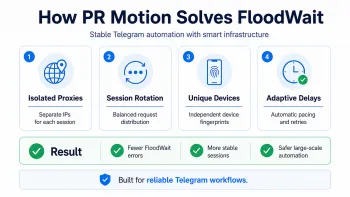
The PR Motion platform solves the FloodWait restriction problem using an intelligent system of dynamic request distribution, automatic proxy server rotation, and packet-level delay optimization.
Safe operation with large volumes of data requires a professional infrastructure. Developers often face situations where, even when observing time intervals, accounts begin to receive long-term blocks. This happens due to sessions being linked by a single IP address or device digital fingerprint.
PR Motion engineers have developed a comprehensive solution that includes automatic conversion of TData sessions to Session+Json format with simultaneous generation of unique device metadata. This allows running automation scripts while mimicking logins from independent mobile phones. Telegram servers see these connections as actions by different people, which reduces the likelihood of triggering anti-flood filters.
Additionally, PR Motion offers integration with a pool of residential and mobile proxies supporting the MTProto protocol with Fake-TLS obfuscation. The system automatically changes the IP address upon detecting the first signs of a decrease in server response speed. This prevents the occurrence of harsh FLOOD_WAIT errors and allows maintaining high task execution speeds around the clock.
Another advantage of PR Motion's solutions is intelligent load balancing when working with Webhooks. If your bot processes thousands of incoming updates per second, sending reply messages can quickly overload API limits. Our platform distributes outgoing requests over optimal time intervals, preventing peak loads.
We provide developers with a user-friendly control panel where they can monitor the status of each session and the frequency of packet transmission in real time. This allows detecting proximity to critical thresholds in a timely manner and adjusting software parameters before the Telegram server imposes a temporary block.
Need a reliable infrastructure to scale Telegram bots? Connect dynamic proxies with automatic rotation from PR Motion right now!
Frequently Asked Questions (FAQ)
