
How to Bypass TikTok Detection Algorithms and Protect an Account Grid Using Residential Proxy Pools for Multi-accounting from PR Motion
- What is Residential Proxy Pools for Multi-accounting in TikTok in Simple Terms
- How Residential Proxy Pools for Multi-accounting Algorithms Work on a Technical Level
- Technical Parameters and Limits of Residential Proxy Pools for Multi-accounting
- How PR Motion Solves the Residential Proxy Pools for Multi-accounting Problem
Scaling account farms on TikTok requires developers and SMM specialists to constantly monitor network parameters. Using Residential Proxy Pools for Multi-accounting technology allows masking automated actions as the activity of real home users. ByteDance algorithms strictly suppress any manipulation attempts using complex fingerprinting and behavioral analysis systems. Without a high-quality network infrastructure, promotion software quickly faces view deductions and blocks. The PR Motion team offers cutting-edge solutions for distributing network load and protecting accounts from shadowbans.
What is Residential Proxy Pools for Multi-accounting in TikTok in Simple Terms
Residential Proxy Pools for Multi-accounting are distributed networks of IP addresses leased from real Internet Service Providers (ISPs) and used for simultaneous management of multiple accounts without the risk of them being linked by security systems.
The physical meaning of the technology lies in replacing the network identifier with an address belonging to a home user. When the TikTok mobile application sends requests to ByteDance servers, the security system checks the autonomous system (ASN) and connection type. Datacenter server IP addresses instantly fall under suspicion, whereas residential addresses possess the maximum level of trust. Session processing and state preservation rules are regulated by RFC 6265 standards.
PR Motion specialists point out that using such pools allows distributing requests from hundreds of profiles across different subnets. This eliminates the linking of accounts based on network characteristics. When integrating proxies with anti-detect browsers, a complete digital persona is created, which ByteDance algorithms cannot distinguish from a real person. Detailed integration rules are described on the official TikTok Developer Portal.
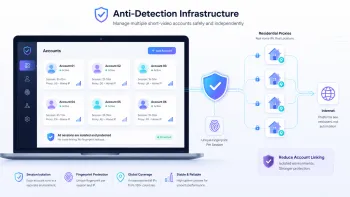
How Residential Proxy Pools for Multi-accounting Algorithms Work on a Technical Level
Residential Proxy Pools for Multi-accounting algorithms work based on dynamic IP address rotation, matching network fingerprints with device hardware characteristics, and distributing requests across clean subnets.
The process of traffic verification on the platform side is built on strict verification of each incoming packet. PR Motion engineers highlight the following stages of this algorithm's operation:
- Request routing. Traffic from automated software is directed to the proxy provider's gateway.
- Selection of a clean IP address. The system automatically selects a free residential address from the pool, taking into account the required geolocation.
- IP reputation check. ByteDance algorithms check the address against autonomous system databases, filtering out server ranges.
- Signature validation. The request is checked for the presence of correct X-Gorgon and SecDeviceToken headers, the structure of which is described in the TikTok-Encryption on GitHub repository.
- TLS fingerprint analysis. The security system matches the TLS handshake parameters with the declared User-Agent.
- Data transmission. Upon successful passing of checks, the request is delivered to TikTok servers, and the user gets access to the content.
Automation library developers confirm that ByteDance algorithms instantly detect template delays between requests. PR Motion engineers solve this problem by implementing algorithms for dynamic IP address rotation and emulating human behavior at the network request level. This allows distributing the load so that the script's actions do not differ from the activity of an ordinary person.
In addition, the security system analyzes the history of the account's interactions with other videos. If a session consists only of views of a single target video without transitions to related videos, the algorithm regards this as manipulation. PR Motion specialists configure session warming scenarios that simulate the full behavior of a real user with all associated actions.
Technical Parameters and Limits of Residential Proxy Pools for Multi-accounting
Technical parameters of Residential Proxy Pools for Multi-accounting determine critical audience retention thresholds, weights of behavioral signals, and limits on the frequency of API requests, beyond which views are invalidated.
Each session is evaluated by multiple parameters. If the system detects discrepancies in critical metrics, views are invalidated. PR Motion specialists have systematized key parameters and limits in a detailed table below, based on security research and open data from private API developers.
| Scenario or Data Type | Limit (Rate Limit / Codec / Metric) | Consequences of Exceeding / Deductions | Data Source |
|---|---|---|---|
| Sticky session lifetime | From 10 to 30 minutes per IP address | Authorization reset, re-login required | Dolphin Anty Blog |
| Share of datacenter IPs in residential pool | Strictly 0% for safe operation | Instant account ban, zero FYP reach | PR Motion Tech Blog |
| API request frequency from a single IP | No more than 15 requests per minute | Temporary IP address block, CAPTCHA appearance | TikTok-X-Gorgon on GitHub |
| Mismatch of TLS fingerprint (JA3/JA4) | 0 mismatches allowed in a session | TCP connection reset, access block | OWASP Session Management |
| Geographic match of IP and time zone | Full match of device and network parameters | Decreased account trust level, view deductions | ExifTool Documentation |
When configuring automation, it is important to remember that limits are calculated dynamically. If a video receives a sudden spike in views with low retention, the ByteDance algorithm pauses the video's promotion. PR Motion engineers recommend gradually increasing activity, starting with minimal values in the first hours after the video is published.
It is also critically important to monitor the uniqueness of network fingerprints. Using identical TLS handshake parameters is quickly recognized by spam filters. PR Motion specialists advise using only high-quality mobile proxies that mask network activity as real users.
How PR Motion Solves the Residential Proxy Pools for Multi-accounting Problem
The PR Motion platform solves the problem of strict Residential Proxy Pools for Multi-accounting limitations by providing a pool of clean residential mobile proxies with CGNAT technology support and automatic IP address rotation via API.
Our network infrastructure is built on physical hardware connected to major cellular carriers. This guarantees that each issued IP address possesses the highest trust level from ByteDance's security systems. Blocking such an address is impossible, as cellular carriers share a single public IP among thousands of real smartphone users.
Solutions from PR Motion include:
- Full support for HTTP(S) and SOCKS5 protocols for integration with any automation software.
- Ability to configure IP address rotation on a flexible schedule or on request via HTTP API.
- Automatic masking of WebRTC and DNS parameters to prevent real IP address leaks.
- Compatibility with all popular anti-detect browsers to create unique digital fingerprints.
Using mobile proxies from PR Motion allows distributing requests from hundreds of accounts through dynamic gateways. This eliminates the linking of profiles based on network characteristics and reduces the likelihood of view deductions to a minimum. You get a stable tool for scaling your business on YouTube and TikTok without the risk of blocks.
Need to scale a TikTok account network without blocks? Connect dynamic residential mobile proxies from PR Motion right now!
Frequently Asked Questions (FAQ)
