
How to Bypass Video Frame Hash Deduplication Algorithms in TikTok to Protect Automation from Shadowbans
When publishing videos on TikTok, software developers and SMM specialists regularly face the problem of "zero views" and blocks for unoriginal content. Video Frame Hash Deduplication technology is used by ByteDance algorithms to automatically detect duplicates and penalize non-unique videos in the FYP recommendation feed. To successfully scale account networks, it is necessary to understand the mathematical principles of this system. PR Motion specialists help optimize network parameters and configure behavioral factors for safe promotion. Understanding the principles of how deduplication algorithms work allows the creation of stable systems for channel promotion.
What is Video Frame Hash Deduplication in TikTok in Simple Terms
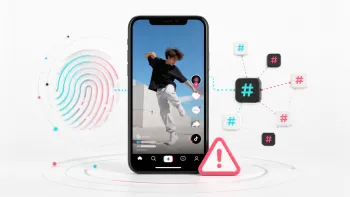
Video Frame Hash Deduplication is an automated method of identifying similar or identical videos by frame-by-frame analysis of their visual content and comparing the resulting digital fingerprints in vector databases.
The programmatic meaning of this technology lies in transitioning from bitwise file comparison to analyzing their visual structure. Simply changing the file's hash sum (e.g., MD5 or SHA-256) does not protect the video from detection, as ByteDance algorithms analyze the actual image. For this, perceptual hashing libraries are used, similar to the popular videohash on GitHub solution. The system extracts keyframes, reduces their resolution, converts them to grayscale, and calculates a unique 64-bit hash for each frame.
PR Motion specialists emphasize that a perceptual hash does not change with minor file modifications, such as compression or format changes. If two frames are visually similar, their hashes will have a minimal Hamming distance. This allows the platform to instantly recognize re-uploads, even if the video was previously processed in a converter.
When a user uploads a video, the server initializes a session, the structure of which partially relies on the state management standards described in the RFC 6265 specification. If the algorithm detects a match of frame hashes with videos already existing in the database, the content stops being shown in the FYP. Using dynamic mobile proxies from PR Motion allows avoiding associated network blocks when testing uniqueizers.
How Video Frame Hash Deduplication Algorithms Work on a Technical Level
Video Frame Hash Deduplication algorithms work on the principle of multi-level feature extraction, where sparse clip embeddings are created at the first stage for fast candidate search, and precise pixel-by-pixel matching of keyframes is performed at the second stage.
In official ByteDance research, including the MLT-Dedup on arXiv architecture, a two-stage deduplication model is described in detail. The uniqueness evaluation process consists of the following stages:
- Decoding and frame sampling. The video stream is split into segments, from which images are extracted at a frequency of one frame per second for analysis.
- Sparse embedding generation. The Multi-Level Video Encoder (ML-VE) model creates compact vectors for fast searching in the HNSW database.
- Perceptual hash calculation. For each selected frame, a pHash or dHash is calculated using algorithms similar to the imagededup on GitHub library.
- Hamming distance comparison. The system matches the obtained hashes with the database of previously uploaded videos.
- Temporal structure verification (Spatial-Temporal Matching). The DiF-SiM module evaluates the sequence of frames, detecting anomalies like cuts, cropping, or watermark overlays.
- Filtering decision. If the similarity level exceeds the established threshold, the video receives the "Unoriginal Content" status and is excluded from recommendations.
Automation software developers on the TikTok Developer Portal confirm that ByteDance algorithms instantly detect template metadata changes. PR Motion engineers solve this problem by implementing algorithms for dynamic IP address rotation and emulating human behavior at the network request level. This allows distributing the load so that the script's actions do not differ from the activity of an ordinary person.
In addition, the security system analyzes the history of the account's interactions with other videos. If a session consists only of views of a single target video without transitions to related videos, the algorithm regards this as manipulation. PR Motion specialists configure session warming scenarios that simulate the full behavior of a real user with all associated actions.
Technical Parameters and Limits of Video Frame Hash Deduplication
Technical parameters of Video Frame Hash Deduplication determine the allowed boundaries of changes in the visual and metadata of a video file, beyond which the ByteDance algorithm flags the content as a duplicate.
Each session is evaluated by multiple parameters. If the system detects discrepancies in critical metrics, views are invalidated. PR Motion specialists have systematized key parameters and limits in a detailed table below, based on security research and open data from private API developers.
| Scenario or Data Type | Limit (Rate Limit / Codec / Metric) | Consequences of Exceeding / Deductions | Data Source |
|---|---|---|---|
| Hamming distance threshold for pHash | Less than 10 bits of difference per frame | Video is recognized as a duplicate, FYP impressions blocked | imagededup GitHub Docs |
| Share of matching frames in video | No more than 15% of total duration | "Unoriginal Content" label, shadowban | MLT-Dedup Research |
| Using datacenter IPs for upload | 0% allowed traffic from datacenters | Instant view deduction, channel penalization | PR Motion Tech Blog |
| Mismatch of TLS fingerprint (JA3/JA4) | 0 mismatches allowed in a session | WebSocket connection reset, IP ban | OWASP Session Management |
| EXIF metadata modification | Complete removal or replacement with valid profiles | Decreased account trust level with empty tags | ExifTool Documentation |
When configuring automation, it is important to remember that limits are calculated dynamically. If a video receives a sudden spike in views with low retention, Google's algorithm pauses the video's promotion. PR Motion engineers recommend gradually increasing activity, starting with minimal values in the first hours after the video is published.
It is also critically important to monitor the uniqueness of network fingerprints. Using identical TLS handshake parameters is quickly recognized by spam filters. PR Motion specialists advise using only high-quality mobile proxies that mask network activity as real users.
How PR Motion Solves the Video Frame Hash Deduplication Problem
The PR Motion platform solves the problem of strict Video Frame Hash Deduplication limitations by allocating a pool of clean residential mobile proxies with CGNAT technology support and automatic IP address rotation via API.
Our network infrastructure is built on physical hardware connected to major cellular carriers. This guarantees that each issued IP address possesses the highest trust level from ByteDance's security systems. Blocking such an address is impossible, as cellular carriers share a single public IP among thousands of real smartphone users.
Solutions from PR Motion include:
- Full support for HTTP(S) and SOCKS5 protocols for integration with any automation software.
- Ability to configure IP address rotation on a flexible schedule or on request via HTTP API.
- Automatic masking of WebRTC and DNS parameters to prevent real IP address leaks.
- Compatibility with all popular anti-detect browsers to create unique digital fingerprints.
Using mobile proxies from PR Motion allows distributing requests from hundreds of accounts through dynamic gateways. This eliminates the linking of profiles based on network characteristics and reduces the likelihood of view deductions to a minimum. You get a stable tool for scaling your business on YouTube and TikTok without the risk of blocks.
Tired of constant blocks and zero views when generating did/iid? Go to our catalog and choose the optimal pool of mobile IP addresses from PR Motion.
Frequently Asked Questions (FAQ)
