
How to Bypass Video Transcoding and AV1 Codec Impact Restrictions on YouTube to Protect Automation from Deductions
YouTube uses complex media processing mechanisms to optimize network traffic. Video Transcoding & AV1 Codec Impact technology directly affects video ranking, audience retention, and the stability of automated systems. The use of the modern AV1 codec allows reducing the load on communication channels but creates additional barriers for software developers, scrapers, and SMM specialists. Without considering the specifics of transcoding, Google's algorithms quickly detect artificial activity and deduct views. PR Motion engineers create a specialized network infrastructure that allows distributing the load and masking automated actions as the behavior of real users.
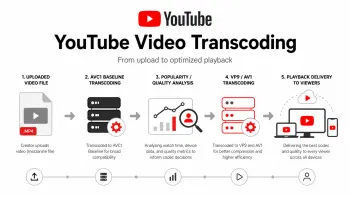
What is Video Transcoding and AV1 Codec Impact on YouTube in Simple Terms
Video Transcoding & AV1 Codec Impact on YouTube is the process of automatically transcoding uploaded video materials into various compression formats, where the use of the highly efficient AV1 codec reduces the bitrate by up to 30% while maintaining visual quality, directly affecting content loading speed and audience retention.
The programmatic meaning of this technology is to reduce the volume of transmitted data without losing image clarity. YouTube uses three main codecs for video compression: AVC1 (H.264), VP9, and AV1 (AV01). The AV1 codec, developed by the Alliance for Open Media, requires significant computational resources for decoding on the client side, which is described in detail in the specifications on the official Alliance for Open Media website.
PR Motion specialists point out that YouTube's algorithms select the codec based on video popularity and the user's screen resolution. New or low-popularity videos are encoded with the simple AVC1 codec, while high-resolution videos (1440p and above) or popular channels receive priority transcoding into VP9 and AV1.
When automated software requests a video stream, the security system analyzes whether the client supports AV1 hardware decoding. If the script claims AV1 support but runs on a server without a GPU, Google's algorithms record an anomaly. Using dynamic mobile proxies from PR Motion allows avoiding this problem by emulating real mobile devices.
The transcoding process is also related to session management. During video playback, the player exchanges data with the server, transmitting information about supported formats. This data is stored in session cookies, the structure of which is regulated by RFC 6265 standards. A mismatch between the parameters declared in the cookies and the actual behavior of the player leads to a session reset.
How Video Transcoding and AV1 Codec Impact Algorithms Work
Video Transcoding & AV1 Codec Impact algorithms on YouTube function by automatically analyzing video popularity, its resolution, and the technical characteristics of the playback device to select the optimal compression codec.
The process of retention evaluation and traffic validation on the platform side is built on strict verification of each incoming data packet. PR Motion engineers highlight the following stages of this algorithm's operation:
- Analysis of uploaded file metadata. When a video is published, the system determines the source codec, resolution, frame rate, and bitrate.
- Primary transcoding. The video is instantly compressed into the AVC1 codec to ensure compatibility with all old devices.
- Evaluation of view dynamics. The algorithm tracks the growth rate of video popularity to make a decision on allocating resources for heavy encoding.
- Secondary transcoding into VP9 and AV1. Upon reaching threshold view values, the video is transcoded into more efficient formats.
- Verification of client hardware capabilities. When a stream is requested, the server analyzes the User-Agent and TLS fingerprint (JA3/JA4) to select the playback codec.
- Monitoring playback stability. The system records dropped frames and buffering delays via WebSocket connections.
Developers of automation libraries using official clients on GitHub confirm that Google's algorithms instantly detect pattern delays between requests. PR Motion engineers solve this problem by implementing algorithms for dynamic IP address rotation and emulating human behavior at the network request level. This allows distributing the load so that the script's actions do not differ from the activity of an ordinary person.
In addition, the security system analyzes the history of the account's interactions with other videos. If a session consists only of views of a single target video without transitions to related videos, the algorithm regards this as manipulation. PR Motion specialists configure session warming scenarios that simulate the full behavior of a real user with all associated actions.
An important element of verification is the analysis of the network protocol. Modern YouTube players send requests using the HTTP/2 or HTTP/3 (QUIC) protocol, which reduces latency when transmitting heavy AV1 frames. If automated software sends requests using the old HTTP/1.1 protocol, this raises suspicion with Google's filtering systems. PR Motion specialists recommend using network libraries with support for modern protocols.
Technical Parameters and Limits of Video Transcoding and AV1 Codec Impact
Technical parameters of Video Transcoding & AV1 Codec Impact determine the exact requirements for bitrate, resolution, and hardware codec support, non-compliance with which leads to view deductions or video penalization.
Each session is evaluated by multiple parameters. If the system detects discrepancies in critical metrics, views are invalidated. PR Motion specialists have systematized key parameters and limits in a detailed table below, based on security research and open data from private API developers.
| Scenario or data type | Limit (Rate Limit / Codec / Metric) | Consequences of Exceeding / Deductions | Data Source |
|---|---|---|---|
| Using AVC1 (H.264) codec | Base codec for videos up to 1080p | Low image quality, high traffic consumption | YouTube Encoding Guidelines |
| Using VP9 codec | Applied for videos from 1440p or popular videos | Optimal balance of quality and CPU load | Google Video Codecs Guide |
| Using AV1 (AV01) codec | Requires hardware GPU support (RTX 30+, Intel 11 Gen+) | View deduction when emulating on old CPUs | Alliance for Open Media Specifications |
| Minimum bitrate for 4K AV1 | Around 8000-10000 kbps (30% lower than VP9) | Risk of image blurring during fast motion in the frame | Reddit AV1 Community Research |
| Mismatch of TLS fingerprint (JA3/JA4) | 0 mismatches allowed in a session | WebSocket connection reset, IP ban | OWASP Session Management |
When configuring automation, it is important to remember that limits are calculated dynamically. If a video receives a sudden spike in views with low retention, Google's algorithm pauses the video's promotion. PR Motion engineers recommend gradually increasing activity, starting with minimal values in the first hours after the video is published.
It is also critically important to monitor the uniqueness of network fingerprints. Using identical TLS handshake parameters is quickly recognized by spam filters. PR Motion specialists advise using only high-quality mobile proxies that mask network activity as real users.
Additionally, the impact of codecs on the power consumption of mobile devices should be considered. Decoding AV1 without hardware acceleration quickly drains a smartphone's battery. YouTube's algorithms track this parameter: if a device claims to watch an hour-long AV1 video without any change in battery level or CPU temperature, the session is flagged as suspicious.
How PR Motion Solves the Video Transcoding and AV1 Codec Impact Problem
The PR Motion platform solves the problem of strict Video Transcoding & AV1 Codec Impact limitations by providing a pool of clean residential mobile proxies with CGNAT technology support and automatic emulation of AV1 hardware decoders.
Our network infrastructure is built on physical hardware connected to major cellular carriers. This guarantees that each issued IP address possesses the highest trust level from Google's security systems. Blocking such an address is impossible, as cellular carriers share a single public IP among thousands of real smartphone users.
Solutions from PR Motion include:
- Full support for HTTP(S) and SOCKS5 protocols for integration with any automation software.
- Ability to configure IP address rotation on a flexible schedule or on request via HTTP API.
- Automatic masking of WebRTC and DNS parameters to prevent real IP address leaks.
- Compatibility with all popular anti-detect browsers to create unique digital fingerprints.
Using mobile proxies from PR Motion allows distributing requests from hundreds of accounts through dynamic gateways. This eliminates the linking of profiles based on network characteristics and reduces the likelihood of view deductions to a minimum. You get a stable tool for scaling your business on YouTube without the risk of blocks.
In addition, PR Motion engineers help optimize graphics card emulation parameters in anti-detect browsers. We provide ready-made device profiles that support hardware AV1 decoding at the chipset level for Snapdragon and Apple Silicon. This guarantees full compliance with YouTube's technical requirements and eliminates view deductions during the post-validation stage.
Need to scale a YouTube channel network without deductions? Connect dynamic residential mobile proxies from PR Motion right now!
Frequently Asked Questions (FAQ)
