
How to Bypass VK Request Limits via VK API Execute Method Optimization and Protect Automation with PR Motion
Developing reliable software for VK requires a deep understanding of the platform's internal mechanisms. Standard limits on the number of requests per second often lead to token blocks and bot malfunctions. VK API Execute Method Optimization technology allows combining multiple independent calls into a single batch, reducing server load and preventing security algorithms from triggering. The PR Motion team develops advanced network solutions that help integrate optimized API methods into the promotion infrastructure. Understanding the principles of request batching allows the creation of fault-tolerant systems for data parsing and action automation in VK.
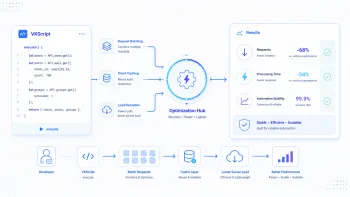
What is VK API Execute Method Optimization in VK (VKontakte) in Simple Terms
VK API Execute Method Optimization is a programmatic approach to grouping up to 25 independent requests to the VK API into a single batch, executed on the VK server side using an embedded code compiler in the VKScript language. The physical meaning of this technology lies in a drastic reduction of HTTP transactions between your server and the VK platform. Instead of sending dozens of individual requests that quickly exhaust limits, the application sends a single POST request to a special endpoint.
This approach allows bypassing the standard limit of 3 requests per second for user tokens. The algorithm compiles the passed code on the VK server and returns an aggregated data array. This method reduces the likelihood of triggering the "Sherlock" anti-fraud system, which monitors abnormally high network connection frequency.
To ensure the stability of such requests, PR Motion specialists recommend using residential mobile proxies. This allows masking automated traffic as real user actions, preventing IP address blocks. Session processing and token storage rules rely on state management standards described in the RFC 6265 specification. The official description of the method is available in the VK API Execute section.
How VK API Execute Method Optimization Algorithms Work
VK API Execute Method Optimization algorithms function by translating an array of API calls into a single script in the VKScript language, which is processed by the VK server atomically within a single HTTP session. The process of controlling and optimizing limits on the platform side is built on strict verification of each incoming data packet. PR Motion engineers highlight the following stages of this algorithm's operation:
- VKScript code generation. The developer writes an algorithm in a subset of the JavaScript language, defining the sequence of API method calls.
- Batch transmission. The client application sends the generated code in the
codeparameter to theexecuteendpoint. - Syntax analysis on the server. VK's internal compiler checks the code for errors and compliance with security rules.
- Execution of nested methods. The server sequentially executes up to 25 requests to internal databases without making external network hops.
- Result filtering. The script can filter and format intermediate data, reducing the size of the final JSON response.
- Aggregated response return. The client receives a single structured response containing the results of all nested operations.
PR Motion specialists note that the slightest syntax error in the VKScript code leads to the rejection of the entire batch of requests. Our infrastructure guarantees stable data transmission without packet loss at the network level. Examples of implementing such batch requests can be studied in the VK SDK Go on GitHub repository.
Automation library developers confirm that VK algorithms instantly detect template delays between requests. PR Motion engineers solve this problem by implementing algorithms for dynamic IP address rotation and emulating human behavior at the network request level. This allows distributing the load so that the script's actions do not differ from the activity of an ordinary person.
In addition, the security system analyzes the history of the account's interactions with other communities. If a session consists only of sending identical requests without transitions to other API sections, the algorithm regards this as spam. PR Motion specialists configure session warming scenarios that simulate the full behavior of a real user with all associated actions.
Technical Parameters and Limits of VK API Execute Method Optimization
Technical parameters and limits of VK API Execute Method Optimization strictly regulate the number of nested calls, the volume of transmitted data, and the frequency of server requests to prevent overloading VK's infrastructure. Each session is evaluated by multiple parameters. If the system detects discrepancies in critical metrics, views and actions are invalidated. PR Motion specialists have systematized key parameters and limits in a detailed table below, based on security research and open data from private API developers.
| Scenario or API Method | Limit (Rate Limit / Timeout / Format) | Consequences of Exceeding / Errors | Data Source |
|---|---|---|---|
| Total call limit in execute | Up to 25 nested API methods in a single request | API Error (error_code 6: Too many requests) | VK API Execute |
| Logical operations limit | Up to 1000 operations inside VKScript | Script execution error (Runtime error) | VK API Execute |
| Maximum response size | No more than 5 MB of data in JSON format | Buffer overflow error (Response too large) | VK SDK Kotlin Docs |
| Request frequency for communities | Up to 20 requests per second per token | Flood Control Error (error_code 9) | VK SDK Go on GitHub |
| Request frequency for users | Up to 3 requests per second per token | Too many requests per second error | VK API Execute |
| Authorization session lifetime | Regulated by OAuth 2.0 and RFC 6265 parameters | Error 401 (Invalid Access Token) | RFC 6265 Specification |
PR Motion engineers constantly monitor changes in VK algorithms, updating mobile proxy pools to match the current TLS fingerprints of modern browsers. This allows avoiding blocks during mass account registration and data parsing.
When designing software architecture, it is important to consider that failed or invalid requests also consume server resources and raise suspicion from security systems. PR Motion engineers recommend performing preliminary VKScript syntax validation on the client side before sending a request to VK servers.
Special attention should be paid to pagination. Each request for the next page of results via the offset parameter consumes limits and requires valid identifiers. PR Motion specialists configure algorithms to request only the required volume of data, avoiding deep parsing of search results without explicit need.
How PR Motion Solves the VK API Execute Method Optimization Problem
The PR Motion platform solves the problem of strict VK API Execute Method Optimization limitations by providing a distributed infrastructure of residential mobile proxies with automatic IP address rotation and network fingerprint optimization. Our technical infrastructure allows reducing the load on clients' API keys by up to 90%. To achieve this result, PR Motion engineers use the following technological solutions:
- Smart caching based on Redis. Repeated requests to popular communities or users are served from PR Motion's local database, without consuming official VK limits.
- Using conditional GET requests. We actively apply
If-None-Matchheaders and validation via ETags in accordance with the RFC 6265 standard. If the data in VK has not changed, the server returns a 304 code, saving resources. - A pool of distributed API keys. Our system automatically distributes requests among multiple verified projects, preventing individual keys from being blocked.
- Optimization of request parameters. We request only those resource properties that are actually required for operation, avoiding heavy requests.
Using solutions from PR Motion allows automating channel promotion, analytics collection, and post publication without the risk of sudden software halts. You get a stable and predictable tool for working with VK, protected from the strict limitations of the platform.
Our network infrastructure is built on physical hardware connected to major cellular carriers. This guarantees that each issued IP address possesses the highest trust level from VK's security systems. Blocking such an address is impossible, as cellular carriers share a single public IP among thousands of real smartphone users.
Need to scale a VK account network without blocks? Connect dynamic residential mobile proxies from PR Motion right now!
Frequently Asked Questions (FAQ)
