
How to Bypass YouTube Data API v3 Quota Optimization Limits and Protect Automation from Blocks
YouTube Data API v3 Quota Optimization is the process of allocating and saving the daily request limit (quota) to Google servers, which directly affects the stability of scrapers, content auto-uploaders, and analytical platforms. When the standard limit of 10,000 units is exceeded, the API returns a 403 error, completely halting the software's operation. Automation developers and SMM engineers are forced to look for ways to reduce request costs to maintain reach and support stable audience retention on channels. The PR Motion team develops advanced solutions for optimizing network requests and distributing infrastructure load. Correct quota configuration allows scaling video promotion without the risk of blocking developer keys.
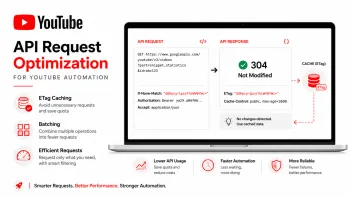
What is YouTube Data API v3 Quota Optimization on YouTube in Simple Terms
YouTube Data API v3 Quota Optimization is a set of software methods aimed at minimizing the consumption of the daily Google Cloud quota budget when interacting with the video hosting platform.
Each project in the Google Developer Console receives a base limit, which is consumed when sending any requests to the API. The physical meaning of this technology is to protect Google servers from overload and spam. Each operation has its own cost in quota units. For example, retrieving video details costs 1 unit, while searching by keywords costs 100 units. The full list of billing rules is described in the official YouTube Data API documentation.
PR Motion specialists point out that without optimization, the standard limit is exhausted within a few minutes of active software operation. If the limit is reached, all subsequent requests are blocked until midnight Pacific Time (PT). This interrupts analytics collection and stops content publication.
To solve this problem, PR Motion engineers apply response caching and conditional HTTP requests. Using ETag headers allows not spending quota on re-downloading unchanged data. This reduces network load and keeps automation operational throughout the day.
How YouTube Data API v3 Quota Optimization Algorithms Work
YouTube Data API v3 Quota Optimization algorithms function on the Google server side, tracking the number and type of incoming requests from each registered API key within a sliding daily window.
The process of controlling and optimizing limits on the platform side is built on strict verification of each incoming data packet. PR Motion specialists highlight the following stages of this algorithm's operation:
- Authorization and identification. With each API call, the server checks the validity of the key or OAuth 2.0 token, matching it with the project in the Google Cloud Console.
- Determining the method cost. The security system refers to the billing table and determines how many quota units will be deducted for the current operation.
- Checking the quota balance. The server compares the request cost with the remaining available units in the developer's project.
- Executing the request or blocking. If the limit is not exhausted, the server returns a JSON response; otherwise, it sends a
403 Quota Exceedederror. - Resetting counters. Every day at midnight Pacific Time (Pacific Time), the accumulated statistics are reset, opening a new request cycle.
Developers of automation libraries on GitHub confirm that unoptimized scripts often make redundant calls. PR Motion specialists eliminate this problem by implementing batch requests (batching). This method allows combining up to 50 small requests into a single HTTP packet, significantly saving network resources.
In addition, Google's algorithms analyze request frequency (Rate Limits) per second. Sudden spikes in activity trigger temporary blocking even if there is free daily quota. PR Motion engineers configure dynamic delays between API calls, emulating the natural intervals of real applications.
Technical Parameters and Limits of YouTube Data API v3 Quota Optimization
Technical parameters of YouTube Data API v3 Quota Optimization determine the exact cost of each API method and the rules for deducting quota units when performing various operations with content.
To build a fault-tolerant automation system, it is necessary to know the exact weights of each request. PR Motion specialists have systematized the current limits and operation costs for 2026 in the table below, compiled based on the official Google quota calculator.
| Scenario or Data Type | Cost (Quota Cost) | Consequences of Exceeding the Limit | Data Source |
|---|---|---|---|
| Base daily project limit | 10,000 units per day | Error 403 (Quota Exceeded), software halt | Google Cloud Console |
| Content search (search.list) | 100 units per single call | Rapid exhaustion of the daily budget in 100 requests | YouTube API Docs |
| Video upload (videos.insert) | 100 units (reduced from 1600 in 2025) | Limit on the number of publications up to 100 per day | Blotato API Guide 2026 |
| Retrieving video details (videos.list) | 1 unit per request | Minimal impact on the daily quota balance | YouTube API Docs |
| Write operations (update / delete) | 50 units per operation | Rapid reduction of the available limit during mass editing | YouTube API Docs |
When designing software architecture, it is important to consider that failed or invalid requests also consume at least 1 quota unit. PR Motion engineers recommend performing preliminary parameter validation on the client side before sending a request to Google servers.
Special attention should be paid to pagination. Each request for the next page of results via the pageToken parameter consumes the full cost of the method. PR Motion specialists configure algorithms to request only the required volume of data, avoiding deep parsing of search results without explicit need.
How PR Motion Solves the YouTube Data API v3 Quota Optimization Problem
The PR Motion platform solves the problem of strict YouTube Data API v3 Quota Optimization limits by implementing a hybrid architecture that combines intelligent caching, API key rotation, and request structure optimization.
Our technical infrastructure allows reducing the load on clients' API keys by up to 90%. To achieve this result, PR Motion engineers use the following technological solutions:
- Smart caching based on Redis. Repeated requests for popular videos or channels are served from PR Motion's local database, without consuming the official Google quota.
- Using conditional GET requests. We actively apply
If-None-Matchheaders and validation via ETags in accordance with the RFC 7232 standard. If the data on YouTube has not changed, the server returns a 304 code, saving quota units. - A pool of distributed API keys. Our system automatically distributes requests among multiple verified projects, preventing individual keys from being blocked.
- Optimization of
partparameters. We request only those resource properties (for example,snippetorstatistics) that are actually required for operation, avoiding heavy requests.
Using solutions from PR Motion allows automating channel promotion, analytics collection, and video publication without the risk of sudden software halts. You get a stable and predictable tool for working with YouTube, protected from the strict limitations of the Google platform.
Tired of constant 403 Quota Exceeded errors in your scripts? Go to our catalog and choose the optimal tools from PR Motion.
Frequently Asked Questions (FAQ)
