
How to Configure Mobile Proxy Rotation (4G/5G CGNAT) in Instagram to Protect Automation from Bans
Automating processes in Instagram requires engineers to apply advanced network technologies to bypass bot detection systems. Using static IP addresses quickly leads to blocks due to strict traffic filtering by Meta. Mobile Proxy Rotation (4G/5G CGNAT) technology solves this problem by masking script activities as the behavior of regular smartphone users. PR Motion specialists configure the network infrastructure so that address rotation occurs invisibly to the platform's protective algorithms. This allows scaling advertising campaigns and scraping data without the risk of losing accounts.
Modern fraud detection algorithms in Meta analyze not only account behavior but also the reputation of the network node. Standard datacenter proxies instantly end up on blacklists because they belong to known hosting providers. Mobile addresses possess the highest trust level (Trust Score) because blocking them would harm millions of real users. PR Motion engineers recommend using dynamic mobile proxies to build a reliable foundation for automation.
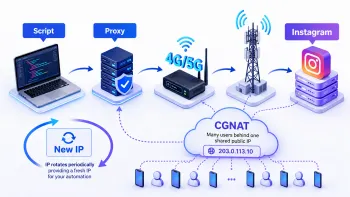
What is Mobile Proxy Rotation (4G/5G CGNAT) in Instagram in Simple Terms
Mobile Proxy Rotation (4G/5G CGNAT) is a technology for dynamically changing the IP addresses of mobile carriers that use Carrier-Grade NAT to simultaneously distribute a single public address among thousands of real users.
Unlike home internet connections, mobile carriers experience a shortage of free IPv4 addresses. To solve this problem, the RFC 6598 standard is applied, which describes CGNAT technology. When you access the network via 4G or 5G, your smartphone shares a single external IP address with a huge number of other subscribers. The carrier assigns the device an address from a private range (100.64.0.0/10) and translates it to the public world through a network address translator.
Instagram's security algorithms are aware of this characteristic of mobile networks. Blocking a single mobile IP address would cut off access for thousands of innocent cellular carrier users. PR Motion engineers leverage this factor by routing automated requests through mobile proxies, which guarantees the highest level of trust from Meta.
Additionally, mobile carriers constantly redistribute ports and sessions among active subscribers. This means that the exact same public IP address can be used to send requests from hundreds of different devices simultaneously. PR Motion specialists emphasize that this architecture makes classic IP-based blocking methods impossible, forcing Instagram to apply much softer filters.
Unlike residential proxies, which are tied to fixed Wi-Fi points and home ISPs, mobile IP addresses are constantly in motion. Meta's systems classify the Autonomous System Numbers (ASNs) of mobile carriers as zones with the highest level of trust. PR Motion engineers note that when using CGNAT, a single IP address can simultaneously serve requests from a regular user scrolling through their feed and your automated script. For Instagram's protective filters, this mixing of traffic creates the perfect disguise, making it practically impossible to isolate bot activity without the risk of blocking real people.
How Mobile Proxy Rotation (4G/5G CGNAT) Algorithms Work
Mobile Proxy Rotation (4G/5G CGNAT) algorithms function by periodically resetting the PDP (Packet Data Protocol) session on the mobile carrier's side, which forces the cell tower to assign a new IP address to the device from the shared pool.
The rotation and traffic processing process consists of several sequential stages:
- The client application or script sends a request to Instagram through a dedicated port on the PR Motion proxy server.
- The proxy server redirects the traffic to a physical 4G/5G modem connected to the mobile carrier's network.
- The modem executes the request to Meta's servers using the current IP address allocated by CGNAT technology.
- When the rotation time arrives (or via an API signal from PR Motion), a brief connection disruption occurs (PDP context reset).
- The modem reconnects to the cell tower and instantly receives a new IP address from the carrier's pool.
This algorithm makes it impossible to track long-term activity from a single network node. Developers of automation libraries, such as the popular instagrapi on GitHub framework, confirm that using dynamic mobile addresses reduces the likelihood of CAPTCHAs to a minimum. PR Motion specialists automate this process, eliminating manual intervention in hardware operation.
Keep in mind that during a PDP context reset, the modem physically disconnects from the network for a few seconds. At this moment, the PR Motion proxy server holds the client connection, preventing session drops in the automated software. As soon as the modem receives a new IP address, data transmission resumes without losing authorization in Instagram.
An IP address change can occur in two ways: via a fixed timer or through an external API request. PR Motion specialists provide clients with a convenient control panel where they can configure the rotation interval from a few minutes to a day. When sending a GET request to a special URL, our system instantly sends a command to reboot the modem. This initiates the procedure of disconnecting from the cell tower and subsequently reconnecting. As a result, the device receives a completely clean IP address from the carrier's pool, which might have previously been used by a regular smartphone in the same area.
Technical Parameters and Limits of Mobile Proxy Rotation (4G/5G CGNAT)
The technical parameters of Mobile Proxy Rotation (4G/5G CGNAT) are determined by the session lifetime, IP address switching speed, and the size of the associated mobile carrier's address pool.
For stable software operation, it is necessary to consider the strict limits of the Meta platform described in the official Meta Graph API documentation. Exceeding these limits, even on mobile proxies, triggers temporary restrictions on account actions.
PR Motion specialists have systematized the key parameters of working with dynamic mobile proxies in the table below.
| Scenario or Data Type | Limit (Rate Limit) | Consequences of Exceeding | Data Source |
|---|---|---|---|
| Single session lifetime (Sticky Session) | From 1 minute to 24 hours | Authorization reset during a sharp change in geolocation | RFC 6265 Standard |
| IP address rotation speed | No more than once every 30 seconds | 429 Too Many Requests error on the Meta server | Meta Graph API Docs |
| Number of accounts per port | Up to 3 active profiles recommended | Appearance of the "Challenge Required" verification | instagrapi GitHub |
| Connection disruption time during rotation | From 2 to 8 seconds | Occurrence of network timeouts in scripts | instagram-private-api on GitHub |
When configuring software, it is important to synchronize rotation intervals with script actions. PR Motion engineers recommend pausing request submissions during an IP address change to avoid sending packets with mismatched network headers.
Additionally, Meta's security systems analyze the MTU (Maximum Transmission Unit) size and TCP Window parameters. In mobile networks, the MTU typically ranges from 1340 to 1420 bytes, whereas in wired networks, this figure is 1500 bytes. A mismatch in these parameters reveals proxy server usage. PR Motion specialists configure network packets so that their structure fully complies with mobile carrier standards.
How PR Motion Solves the Mobile Proxy Rotation (4G/5G CGNAT) Restrictions
The PR Motion platform solves the limitations of Mobile Proxy Rotation (4G/5G CGNAT) by allocating private ports with flexible rotation configuration via API or timer, guaranteeing complete traffic masking to mimic real mobile users.
Our infrastructure is built on our own pool of physical 4G/5G modems located in key regions of the world. We do not use virtual or compromised devices, which guarantees the cleanliness of every assigned IP address. Clients gain full control over the network identifier rotation process.
Solutions from PR Motion include:
- Instant IP address change on request via a simple HTTP API.
- Support for HTTP(S) and SOCKS5 protocols for compatibility with any software.
- Automatic synchronization of the proxy's time zone with the system time of your anti-detect browser.
- Complete WebRTC masking to prevent real IP address leaks.
Each port from PR Motion operates on a dedicated physical modem with unlimited traffic. This eliminates speed drops or bandwidth throttling when performing resource-intensive tasks, including media file scraping or bulk Reels uploads.
Using our mobile proxies allows developers to build scalable automation systems that run smoothly 24/7. You protect your accounts from bans and secure a stable communication channel with Instagram's servers.
Need to scale an Instagram account network without bans? Connect dynamic residential mobile proxies from PR Motion right now!
Frequently Asked Questions (FAQ)
