
TikTok Search Hub: How Brands Turn Search, Challenges, and UGC into a Unified Campaign
- What Is TikTok Search Hub?
- Why One Viral Video Is Not Enough
- How Branded Buzz, Challenges, and Search Hub Work Together
- How a Challenge Generates Search Demand
- What Role Does UGC Play?
- How to Prepare a Search Hub Campaign
- Which Metrics Should You Track?
- Who Is Search Hub Suitable For?
- What Can Brands Do Without Access to Search Hub?
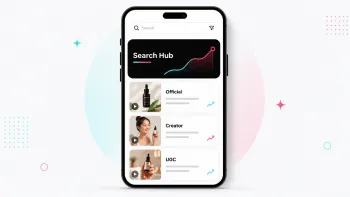
TikTok Search Hub is a branded area at the top of TikTok search results. It brings together official videos, creator content, user-generated posts, banners, CTAs, and links to accounts or products. This turns search from the final point of passing interest into a controlled part of a marketing campaign.
The format is particularly useful for brands that work with influencers, launch challenges, or receive large volumes of UGC. A standalone viral video attracts attention. Search Hub helps capture the resulting demand and guide users toward the next action: watching reviews, visiting an account, or making a purchase.
What Is TikTok Search Hub?
Search Hub is a customizable branded search page. It appears at the top of results for selected queries and creates a unified product discovery journey. Instead of seeing a random selection of posts, users see a collection of content built around a brand, category, or event.
TikTok introduced Search Hubs alongside the Branded Buzz solution in May 2026. In its official Search Hubs overview, the platform identifies four formats:
- Branded Search Hub — an area for branded search queries.
- E-commerce Branded Search Hub — a format for TikTok Shop sellers.
- Category Search Hub — placement for category-related queries that do not include a brand name.
- Sponsor Search Hub — a format for major events, premieres, and search peaks.
Availability depends on the market and advertiser category. Search Hub should not be treated as a standard self-service feature. Activation usually requires coordination with a TikTok representative.
Why One Viral Video Is Not Enough
Viral content attracts attention, but it does not guarantee control over the user’s next steps. After watching a video, a person may open search, discover competitors, read random reviews, or fail to find the official account.
Search Hub connects reach in the recommendation feed with search intent. It helps bring official and user-generated content together in one place, continue communication after the initial view, and shorten the path between interest and a target action.
How Branded Buzz, Challenges, and Search Hub Work Together
Branded Buzz creates a wave of content, Keyword Amplifier channels attention into search, and Search Hub captures the interested audience. Together, these tools form a unified funnel.
- The brand selects a topic, product, or campaign mechanic.
- Creators publish the first videos and explain how to participate.
- Users repeat the mechanic and create UGC.
- The name of the challenge, product, or problem appears more frequently in search.
- Keyword Amplifier directs audiences from comments and recommendations to Search Hub.
- In Search Hub, users see official content, reviews, UGC, and offers.
- The best posts receive additional paid promotion.
The advantage of this model is the smooth transition from native video to product research. Creator content generates interest. Search confirms intent. Search Hub continues the user’s introduction to the brand within TikTok’s familiar interface.
How a Challenge Generates Search Demand
A successful challenge should not only generate views but also create a clear search object. This could be a product name, a unique mechanic, a problem, or a short phrase that is easy to repeat in speech and text.
The key phrase should appear in spoken dialogue, on-screen text, the caption, the hashtag, and a comment encouraging users to learn more. This gives both the platform and the audience a consistent context.
Before launch, it is useful to study search suggestions, questions under competitors’ videos, and topics with content gaps. The Creator Search Insights tool highlights popular topics and helps identify the queries users enter within TikTok.
What Role Does UGC Play?
UGC turns an advertising promise into social proof. An official video explains the brand’s position, while user-generated videos show the product in different situations, answer questions, and address objections.
Useful Search Hub content includes posts that demonstrate results, show unboxings, compare options, answer common questions, or confirm participation in a challenge.
A brand cannot automatically use every video it discovers. Quality, tone, safety, and creator permission must be considered. TikTok Content Suite helps brands find mentions in captions, hashtags, spoken audio, and on-screen text. After review and authorization, suitable posts can be turned into advertising creatives.
How to Prepare a Search Hub Campaign
1. Build a Search Keyword Set
Start with audience intent. Collect branded, category-based, problem-focused, and comparison queries. Add phrases from comments, reviews, and customer support requests. They often reflect the language users actually speak more accurately than a standard semantic keyword list.
2. Choose a Central Idea
The idea should be connected to the product and easy to repeat. An overly complicated mechanic reduces participation. An overly broad one may generate views without creating search demand around the brand. A strong format can be explained in one sentence and demonstrated within the first few seconds of the video.
3. Involve Creators
Several creators from different audience segments can demonstrate more use cases than one major influencer. The brief should specify the key search query, required phrase, on-screen text, brand mention rules, and target action. At the same time, creators should retain enough creative freedom.
4. Launch a Simple UGC Mechanic
Users should immediately understand what they need to do. Formats such as “repeat,” “test,” “compare,” “show the result,” and “share your version” work well. Participation should not require complicated editing.
5. Organize Search Hub by User Scenario
Divide content by purpose: product introduction, instructions, reviews, comparisons, answers to questions, and the best participant submissions. Users should be able to quickly find content that matches their intent.
6. Amplify the Best Posts
Select videos with strong retention, engagement, and click-through performance. They can be promoted through Spark Ads. Search Ads Campaign remains a separate tool: it displays ads based on keywords, while Search Hub creates a complete branded search environment.
Which Metrics Should You Track?
Performance should not be measured by views alone. Search Hub combines several stages of the funnel, so metrics should be divided according to the role of each type of content.
| Stage | Key Metrics |
|---|---|
| Creator content | Views, retention, completion rate, engagement |
| Challenge and UGC | Number of posts, creators, quality of participation |
| Search | Growth in branded and category-related queries |
| Search Hub | Hub views, interactions, clicks |
| Advertising and business | CTR, CPC, CPA, conversions, leads, and sales |
One notable example is L’Oréal’s campaign, which combined Branded Buzz, Keyword Amplifier, and a personalized Search Hub. According to TikTok, the campaign generated 7.5 times more organic views than forecast and a 2.9-fold increase in search volume. These results relate to a specific campaign and do not guarantee similar performance for other brands.
Who Is Search Hub Suitable For?
Search Hub is suitable for companies that already have a content ecosystem or the resources required to build one. The format is particularly useful for product launches, seasonal campaigns, premieres, and categories that users actively research through TikTok.
The greatest potential is available to major consumer brands, online stores, media projects, companies with regular creator partnerships, and brands that already receive a significant volume of UGC.
For a small local business, the format may be excessive. Without a budget for large-scale creator campaigns, it is better to begin with search optimization for the profile, a series of videos targeting one query cluster, and promotion of the best-performing posts.
What Can Brands Do Without Access to Search Hub?
The basic mechanic can be partially recreated using accessible tools:
- Optimize the account name, bio, and posts for the main search query.
- Create a series of videos that answer different questions related to one topic.
- Involve micro-influencers working within the same semantic direction.
- Launch a simple UGC creation mechanic.
- Pin a review, an instructional video, and social proof to the profile.
- Promote the strongest posts through Spark Ads and search advertising.
This approach does not create a separate area at the top of search results. However, it does connect creator content, UGC, and TikTok SEO into a unified funnel.
Want to support the initial reach of your key posts? Explore PRMotion’s social media promotion tools to attract attention to branded content more quickly and build social proof.
Frequently Asked Questions (FAQ)
